Friday, June 11, 2010

Follistim: A Photo Essay

In the evenings we do Lupron, which we already covered, and Follistim.  Follistim comes in a handy-dandy pen gizmo and is way more convenient than any of the other drugs.  It's also wildly expensive.  Here's the kit:


The blue case holds the injection pen; the cardboard box holds a cartridge of drug and some disposable needles for the pen.  When we open the case, the pen kit looks like this:


So you've got the pen, you've got some needles (in the little pink things), you've got a place to carry some sterile wipes --- all in a nice zip-up case.  How convenient!  Er, except that once the pen is loaded with drug, the whole shooting match has to be stored in a refrigerator.  Which makes it significantly less convenient, and sort of defies the whole point of the snazzy carrying-case.  Well, whatever. 

The pen itself is a lot like an ink pen with a reloadable cartridge:


So the piece at left is just a cap, liek the cap on any pen.  At top is the bottom of the pen; you stick the catridge in from right to left, then screw on the bit with the plunger.  The cartridge itself is the glass thing at bottom.  Close-up, it looks like this:


It's small.  Here it is loaded in the pen and held in my hand.  The cartridge is about the length of the last two digits of my pinky finger, and much, much narrower; it's maybe 5mm in diameter.  The list price for this 600 unit cartridge is more than $500.  The good news is, they do usually have some extra medicine in them; we got >700 units out of the first "600 unit" cartridge.


Once the cartridge is loaded in the pen, you need to put a needle on it.  The needles come in these little containers that look like miniature versions of the creamer containers at Denny's:


You take the paper top off (again, it's like a creamer container) and just screw the whole thing on the end of the pen:


Then pull off the creamer-container and an internal needle cover to expose the needle.  It's very small; this is not only a sub-q shot, it's one I haven't kludged together from old IM needles.


With the needle on, it's dial-a-dose: you turn the know on the end of the pen until the desired dose appears in the window.  We started out with a 125 unit dose; now we're up to 150.


Ready to go, the pen looks like this:


To use it, I stick it in Sarah's belly and push the plunger down with my thumb.  The dose injected is determined in advance by the dial-a-dose thingy, so it's stress-free (for me).  In the event that the cartridge runs out in the middle of an injection, it's no big deal; you just note on the dial how much drug was left to be injected, reload a new cartridge and needle, and finish the injection.  Of course, this means another stick, which Sarah doesn't care for.  But them's the breaks; given the expense of this stuff, you really really want to use every bit of it.

Menopur: A Photo Essay

So this is the "kit" for our morning Menopur injection:


It's actually very ad hoc, being an amalgam of new drugs and old (from the Ainsleigh cycle) paraphernalia. Clockwise from top left, we have: sterile alcohol pads to clean the vials and injection sites; the syringe, prepackages with a needle that's much too big and so never used; a Q-Cap (see below); the vials of medicine and diluant (ditto); and the actual needle we'll use (in the center).

This particular medicine comes as a powder.  I'm not totally sure why.  It seems likely that the drug is not stable in solution; both the Follistim and Lupron have to be refrigerated to keep from decaying, so perhaps the crystalline form can be stored longer and cheaper, saving the manufacturer and distributors money.  Also, this packaging makes the concentration of the injected solution adjustable.  When you buy solutions like Follistim, the only way to get a bigger dose of the drug is to inject a larger volume of the solution.  With the Menopur, you can get a larger dose by dissolving multiple vials of crystalling drug in a single dose of the saline diluant.  Of course, the flip side is that the volumes we're dealing with here are much greater; 1 mL of Menopur solution vs. 0.05mL of Lupron or some similarly small volume of Follistim.  So it seems like the stability thing is the most likely explanation.

In any case, the technique here is to use this little doodad called a Q-Cap to mix the saline solution (brown label) with the powdered drug (white label).  First, the needle that came with the syringe is removed and the Q-Cap screwed on in its place:


It's hard to see, but the Q-Cap has an outer shell that clips over the lip of the drug/diluant vial, and an inner spike that punches through the rubber top of the sterile vial.  So, the syringe clips over the vial like so:


One draws 1mL or so of the saline back into the syringe, then unclips the Q-Cap from the diluant vial:


and clips it to the drug vial:


Even the tiniest amount of diluant dissolves the drug powder completely:


the resulting mixture is then drawn back up into the syringe, and the Q-Cap unscrewed and discarded:


The injection needle is attached, and we're ready to go.


For scale, here's what the shot looks like in my hand:


Note that this needle is actally much too big.  The shot is subcutaneous, which is a fancy way to say it goes into the fat just under your skin.  For this the needle really only neds to be a half inch long.  However, we had these 1.5 inch needles laying around, and we're trying to cut costs wherever we can.  So we decided to just go with it.  My brilliant plan?  Only stick the 1.5in needle a third of the way in.  Presto, a half-inch needle.  How do you like them apples.

Anyway the shot goes lickety-split, but because of the volume it hurts Sarah more and causes more bruising.  The poor girl has quite the pattern of bruises across her belly, but she's hanging in there.

Stimulus

So, as of last Friday (June 11th) we've entered the stimulation phase of the IVF process.  The basic idea is: hyper-stimulate Sarah's ovaries so that a large number of eggs begin maturing.  Over a span of 10 days or so, the eggs develop rapidly; then, when they're just about to be released, the doc goes in and "retrieves" them for fertilization in the Petri dish.  More on that later.

During the stimulation phase, Sarah takes a combination of hormone injections.  In the morning, she takes Menopur, a so-called "menotropin", meaning a mixture of follicle stimulating hormone (FSH) and luteinizing hormone (LH).  Together, these hormones stimulate the development of follicles, the structures that house eggs as they develop and prepare for fertilization.  In the evening she takes a larger dose of FSH in the form of Follistim, and a smaller dose of Lupron, which as we discussed before is an LH agonist.

The process is monitored in two ways.  The first is easy to understand: Sarah has ultrasounds exams, in which a technician uses the ultrasound machine to look at her ovaries and count the number of follicles.  As the follicles get larger, the tech will not only count them but measure their size.  The ideal result from one of these exams is a finding that:

1.  there are lots of follicles;
2.  they're bigger than they were in the previous exam; and
3.  they're all about the same size.

This is all very intuitive, right?  You want lots of eggs to fertilize; you want them to be growing and maturing; you want them all to be ready at the same time. So, what's ready?  Well, we're looking for the follicles to grow to somewhere right around 2.0cm in diameter.  If you're big like me, that's about the size of your thumbnail.  If you're small like Sarah, it's more like the size of you big toenail.

In addition to the ultrasounds, Sarah has blood drawn regularly.  The draw is for an estradiol (E2) assay.  The idea is, we want to see E2 levels going up and up and up.  The slope of this curve tells the medical team that the eggs are developing on schedule.

So what do the words "frequent" and "regular" mean in this context?  Well, we went for a "baseline" ultrasound and E2 test on June 1st.  This was the low point in Sarah's cycle; it tells the docs what her ovaries and hormone levels look like sans stimulation.  On Friday the 4th, we started the stimulation phase: Menopur in the morning, Lupron and Follistim in the evening.  We went for the first blood draw on Monday the 7th.  Then we went for blood tests on Wednesday and Friday, and we go again on Sunday.  The first ultrasound was on Wednesday the 9th; we had another Friday and will have a third on Sunday. All told, then, "frequent" means: at least every other day.  As retrieval gets closer, it may become every day; it won't surprise me if after Sundays tests we're scheduled to go for more tests on Monday.

More on the results of these tests momentarily.

Sunday, May 23, 2010

First Shot

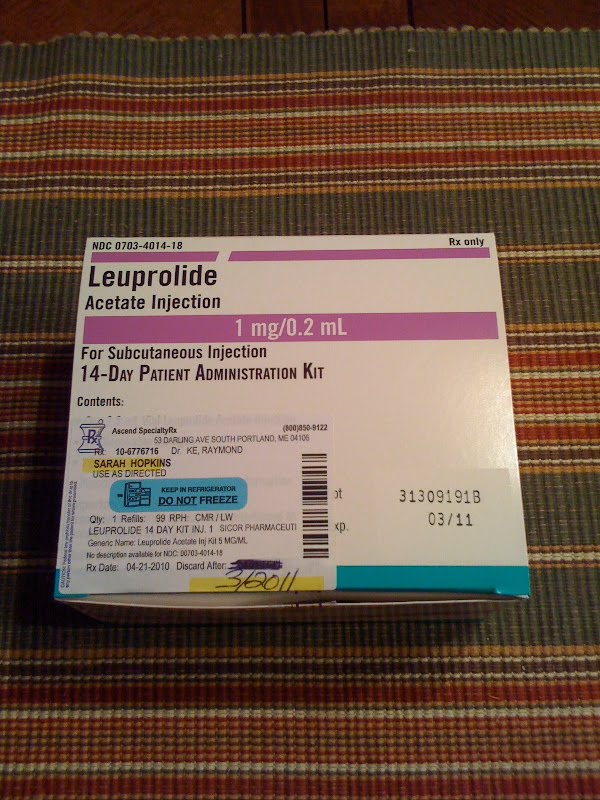
The first injectable drug in the IVF cycle is called leuprolide. It looks like this:


Opening it up, you find a 14-day kit that includes the drug, the required needles, and even the alcohol pads needed to clean the injection site:


The little vial there holds 2.8mL of the drug. That's 14 of the typical 0.2mL doses. We're using it for a different purpose and so use a smaller 0.1mL dose. We paid $99.00 for it.  The needle is tiny. Here's the shot, loaded and ready:


The fingers there are mine, so they're pretty big, but I think the scale is clear.  The needle is very short.  It's a subcutaneous shot.  That means it goes into the fat under the skin.  In practice, what I do is clean a patch of Sarah's tummy with the alcohol pad, pinch her skin, stick the needle in, and inject the drug.  The drug is aqueous, so it goes in quick.  Whole thing is over in five seconds max.

Trial Transfer

On Thursday we had trial transfer, which is a sort of dress rehearsal for embryo transfer.  In both cases an external ultrasound is used to guide the insertion of a catheter through the cervix and into the uterus.  (In the case of embryo transfer, the embryos are then squirted through the catheter and out into the uterus.)  The idea is that every woman's anatomy is slightly different, so it's best to practice the transfer ahead of time, before there are embryos in the room and the clock is ticking.

In Sarah's case, the transfer is simple and takes just a minute or two.  So that's good.  We also got a chance to speak to the doc about the results of all of the lab tests from a few weeks ago.  The results are all good, too:  all of Sarah's blood tests are in order, and I remain capable of fertilizing every oocyte in the state of Mississippi in one fell swoop.

Perhaps more importantly, Trial Transfer Day is also Payment Day.  So Thursday at 1:00 we forked over two checks (we pay separate global fees for lab work and doctors' services) totaling about $7,000.  Some of it can be refunded, I guess, but we're now totally committed.  Later that night, Sarah posted on Facebook that she'd "officially begun".  I think that's right; from here on out, everything is paid for, scheduled, and programmed.

Sunday, May 16, 2010

Surgery

The original schedule for our IVF cycle looked like this: trial transfer on May 6th; egg recovery the week of May 31st -- June 4th; embryo transfer sometime in the range June 3rd -- June 9th. As a part of this schedule, we went in for preliminary testing on April 22nd.  We each had a test done: semenalysis for me, sonohysterogram for Sarah. 

A sonohysterogram is a test in which the technician inserts a catheter through the cervix, then pumps water into the uterus to sort of inflate it.  In the meantime, she uses an internal ultrasound to scope out the shape and texture of the uterus as it inflates.  This allows the tech to detect any defects in the uterus or its lining. 

Well, by now you know where this story is going: they found such defects.  Specifically, they identified rough patches in the uterine lining that they figured were likely to be endometrial polyps.  These are common in PCOS patients, and usually benign; if you're a woman with irregular periods, you may have them and not even know.  For our purposes, they;'re troubling for a  simple reason: the polyp occupies a region of the uterine wall and renders that region useless for embryo implantation.  So, if 10% of the uterine wall is covered by polyps, the chance of successful implantation is reduced by 10%. 

Obviously when you spend $10K or more on an IVF cycle, you want to maximize the chance that it will work.  So, when we heard the news we scheduled surgery to remove the polyps. The surgery is minimally invasive; they insert a endoscope into the unterus by way of the cervix, and the only cuts are the ones that separate the polyps from the uterus.  That surgery was performed on Friday, May 14th.  It was entirely successful; the polyps (which I have pictures of; I may post them later if Sarah agrees) were removed, and as I write this (on Sunday the 16th) Sarah is more or less fully recovered. 

So now we're on again.  The new schedule looks like this: trial transfer on Thursday May 20th; egg retrieval the week of June 14th -- 19th; embryo transfer sometime between June 16th and June 23rd; a yes-or-no pregnancy test soemtime around the first of July; and a one-baby-or-two ultrasound (as needed) in late July. 

I'll add descriptions of each of these procedures as we go.  It's going to come fast now.

The Easy Problem And The Hard Problem

We're really beginning tomorrow.  More on that in a minute.  As I started to write a post about what's happening tomorrow, I became clear that I wasn't nearly ready to do all that.  The post required so much background information that it got totally clogged with commas and dashes and parentheses, oh my.  About halfway through, I decided the whole thing was unreadable, so I ripped all that stuff out and put it in this post.  If you know the Story So Far, feel free to skip ahead to the next post.

Sarah and I have two basic fertility problems.  You can think of them as the Easy Problem and the Hard Problem.  We'll take them one at a time. 

The Easy Problem is a condition called polycystic ovarian syndrome (PCOS).  Not too very long ago, this diagnosis was somewhat controversial; when we were first diagnosed in 2005, I looked into it and found a heated argument about whether it existed at all.  In the intervening years, this controversy appears to have died down.  There's still not a definitive "cause" of PCOS, but the most popular theory seems to be that PCOS is a sort of pre-diabetic condition.  Women with PCOS don't have unregulated blood sugar, but they do have much higher than normal levels of blood insulin.  The body is still producing insulin and the insulin is still doing its job, but only at a much higher concentration (ie, dose) than normal.  And at this higher-than-normal concentration, insulin starts to have deleterious side effects.  Most importantly to the fertility patient, the excess insulin interferes with the woman's normal hormonal cycle. The result is as you'd expect: irregular mentrual cycles, anovulation, and infertility. 

Treatment for the Easy Problem is simple and cheap.  It resembles the treatment for Type II diabetes: control your diet, exercise, lose weight, and take a drug called metformin, aka Glucophage.  In diabetics, of course, the goal of these measures is to lower and control blood sugar concentration; in PCOS patients, the goal is to lower and control blood insulin concentration so that the body's other hormones can do their job.  In our case, this treatment has been largely (if incompletely; more on that in the next post) successful.  It also costs about $36/month (the cost of the metformin at our local drug store; throw in Sarah's half of the gym membership and you're up to a whopping $56/month), which is nice.  And all would be well, if it weren't for the Hard Problem.

The Hard Problem is that Sarah's tubes, um, do not exist. When treatment with metformin, Provera, Clomid,  etc. failed, she underwent a test called a hysterosalpingogram.  In an HSG, a clamp is placed over the cervix and an X-ray reflective dye forced through the clamp into the uterus.  Meanwhile, a radiology type watches what happens with a fluoroscope.  In a woman with normal anatomy, the dye will fill the uterus, then flow up the fallopian tubes and spill out into the abdominal cavity near the ovaries.  In Sarah, the dye flowed up the tubes and stopped; her tubes were closed at the ovary end.  Shortly after learning this, Sarah underwent a laprascopic surgery to open the tubes; er OB/GYN basically went in and cut her tubes open at the ovary end.  This was fairly expensive (I think we laid out about $3000 for it)  and not that promising as a treatment, but it was the Next Step at that point so we did it. After the surgery, the doc (again, this is our local OB, not our ART guy in Memphis)  put Sarah on a mega-dose of Clomid for six months --- the idea being that the tubes he cut open were only likely to stay open for six months, so it was best to maximize the chance that we'd get pregnant in that time.

(As an aside: if you've never lived with a woman on the maximum dose of Clomid...well, it's an adventure.  A chemistry friend of mine coined the term "emotionally labile".  I think that works.) 

Well, six months came and went, and no baby.  So OB guy referred us to ART guy, who explained that (contrary to what you learned in 7th-grade health class) the fallopian tube is not simply an tube for the egg to fall through, but an active participant in the fertilization process.  The ovary end of the tube is supposed to have "petals", like a flower; these petals are supposed to reach out grab the egg after ovulation, and cilia on the inside of the tube are supposed to move the egg down the tube.  Even after they'd been surgically opened, Sarah's tubes were so badly damaged that they could not perform these functions.  With this in mind, Dr. Ke (a/k/a ART guy) told us that:

1.  our best chance to get pregnant was through in vitro fertilization (IVF), a procedure in which the action that usually happens in the fallopian tubes instead happens in a petri dish; and,
2.  once we decided to go ahead with IVF, it would be best to have Sarah's tubes removed, since blocked tubes fill with a toxic fluid that can spill back into the uterus and reduce the chance of having a successful pregnancy through IVF.

After careful consideration, we decided to go ahead with these recommendations.  In the Spring of 2006, Sarah had her tubes removed.  Shortly thereafter we underwent a successful IVF cycle, and our daughter Ainsleigh was born in the Spring of 2007.  (She's gone now, but that is another story.)  But the both the Easy Problem and the Hard Problem remained.  And now, in 2010, we've got to deal with them all over again. 

And here we go...